Pages
A welcome to readers
As a resident of this planet for more than four fifths of a century, I have enjoyed both successes and disappointments in a wide variety of vocations, avocations, and life experiences. This blog satisfies my desire to share some thoughts and observations--trenchant and prosaic--with those who are searching for diversions which are interesting, poignant and occasionally funny. I also plan to share recommendations about good/great movies I've watched and books and articles which I've found particularly mind-opening, entertaining, instructive. In addition, I can't pass up the opportunity to reflect publicly on how I am experiencing the so-called Golden Years. Write anytime:
markmarv2004@yahoo.com
Saturday, February 7, 2015
Tuesday, February 3, 2015
Thursday, January 22, 2015
IMAGINE SOMETHING DIFFERENT
Read more to find out how the 80 richest individual people in the world ( a number that could easily fit onto two busses [not one as claimed]) control more wealth than 3.5 billion of their fellow humans…and what this means. Why is this so? Does it help to know that this year, more than half of the people in our Congress are millionaires? Hmmm.
Imagine Something Different
Posted on Jan 21, 2015
“Imagine if we did something different.”
Those were just seven words out of close to 7,000 that President Barack Obama spoke during his State of the Union address. He was addressing both houses of Congress, which are controlled by his bitter foes. Most importantly, though, he was addressing the country. Obama employed characteristically soaring rhetoric to deliver his message of bipartisanship. “The shadow of crisis has passed, and the State of the Union is strong,” he assured us.
From whose lives has the shadow of crisis passed? And for whom is this Union strong?
“Will we accept an economy where only a few of us do spectacularly well?” Obama asked. “Or will we commit ourselves to an economy that generates rising incomes and chances for everyone who makes the effort?”
Oxfam, the international anti-poverty organization, weighed in on the question, releasing a report the day before the speech called “Wealth: Having It All and Wanting More.” Oxfam analyzed data from the Credit Suisse Global Wealth Databook 2014 and the Forbes list of the world’s billionaires to determine some shocking facts about global inequality.
One way the wealthy manage to increase their wealth, Oxfam reports, is through lobbying. The report identifies two industries, finance/insurance and pharmaceutical/health care, as major sources of wealth for the richest, and as principal founts of political contributions. Hundreds of millions of dollars are spent by these industries annually to shape public policy and safeguard profits.
“For far too long, lobbyists have rigged the tax code with loopholes that let some corporations pay nothing while others pay full freight,” President Obama said in his State of the Union. “They’ve riddled it with giveaways the super-rich don’t need, denying a break to middle-class families who do.”
Obama has proposed increasing taxes on the very rich: “Let’s close the loopholes that lead to inequality by allowing the top 1 percent to avoid paying taxes on their accumulated wealth.”
Pulitzer Prize-winning journalist David Cay Johnston is an expert on taxes. We spoke to him on the “Democracy Now!” news hour soon after the State of the Union. “The idea that we shouldn’t adjust the tax rates for people at the top and doing so is somehow class warfare is absurd,” he said. “The president is proposing that for those people in the top one-half of 1 percent—and almost all the money would be paid by the top tenth of 1 percent, people who make over $2 million—that their capital-gains tax rate be at the Ronald Reagan rate of 28 percent,” Johnston summarized. “And Republicans are saying that that’s outrageous. Well, I’m sorry, they’re always telling us Ronald Reagan is a saint.”
What would these taxes pay for? Among other things, Obama pledged to make child care more affordable. He promised free community-college education. These are genuine, good ideas. After his address, Republicans repeatedly said he was for the “redistribution of wealth,” code for socialism. But wealth IS being redistributed by the government—upward, from the poor to the rich—through policies promoted by both major parties, from tax loopholes to “free trade” deals that protect corporate profits over workers’ rights.
And who is promulgating these laws? The Center for Responsive Politics, a political contribution watchdog group, reports that, for the first time ever, more than half of the members of Congress are millionaires. The group states that this “represents a watershed moment at a time when lawmakers are debating issues like unemployment benefits, food stamps and the minimum wage, which affect people with far fewer resources, as well as considering an overhaul of the tax code.”
As President Obama said in his State of the Union, “To everyone in this Congress who still refuses to raise the minimum wage, I say this: If you truly believe you could work full time and support a family on less than $15,000 a year, try it.”
Growing economic inequality not only hurts the poor, and the working and middle class, but destabilizes society overall. Yes, we must “imagine if we did something different.” Everyone must have a stake in the state of the union.
Denis Moynihan contributed research to this column.
Amy Goodman is the host of “Democracy Now!,” a daily international TV/radio news hour airing on more than 1,200 stations in North America. She is the co-author of “The Silenced Majority,” a New York Times best-seller.
© 2015 Amy Goodman
Tuesday, November 25, 2014
LOTS OF TRUTH: FERGUSON'S TEARS AND OURS
Boils down to money in politics I fear. Greed too. And look at what the message is from Ferguson, MO as of last night--from the bottom end of the 90% economically and those who feel disenfranchised or ignored or persecuted because of their color/race. The amount of evident hate is scary and discouraging, especially so when the governing class will "little note nor long remember…" after the glass is swept up and the tear gas smoke clears. Nothing to celebrate in Ferguson this Thanksgiving.
This post originally ran on Robert Reich’s Web page.
The Real Reason Behind the Democrats’ Big Midterm Losses
http://www.truthdig.com/report/item/the_real_reason_behind_the_democrats_big_midterm_losses_20141111/
Posted on Nov 11, 2014
By Robert Reich
This post originally ran on Robert Reich’s Web page.
The President blames himself for the Democrat’s big losses Election Day.
“We have not been successful in going out there and letting people know what it is that we’re trying to do and why this is the right direction,” he said Sunday.
In other words, he didn’t sufficiently tout the Administration’s accomplishments.
I respectfully disagree.
If you want a single reason for why Democrats lost big on Election Day 2014 it’s this: Median household income continues to drop.
This is the first “recovery” in memory when this has happened.
Jobs are coming back but wages aren’t.
Every month the job numbers grow but the wage numbers go nowhere.
Most new jobs are in part-time or low-paying positions. They pay less than the jobs lost in the Great Recession.
This wageless recovery has been made all the worse because pay is less predictable than ever.
Most Americans don’t know what they’ll be earning next year or even next month. Two-thirdsare now living paycheck to paycheck.
So why is this called a “recovery” at all? Because, technically, the economy is growing.
But almost all the gains from that growth are going to a small minority at the top.
In fact, 100 percentof the gains have gone to the best-off 10 percent. Ninety-five percent have gone to the top 1 percent.
The stock market has boomed. Corporate profits are through the roof. CEO pay, in the stratosphere.
Yet most Americans feel like they’re still in a recession.
And they’re convinced the game is rigged against them.
Fifty years ago, just 29 percent of voters believed government is “run by a few big interests looking out for themselves.”
Now, 79 percentthink so.
According to Pew, the percentage of Americans who believe most people who want to get ahead can do so through hard work has plummeted 14 pointssince 2000.
What the President and other Democrats failed to communicate wasn’t their accomplishments.
It was their understanding that the economy is failing most Americans and big money is overrunning our democracy.
And they failed to convey their commitment to an economy and a democracy that serve the vast majority rather than a minority at the top.
Some Democrats even ran on not being Barack Obama.
That’s no way to win. Americans want someone fighting for them, not running away from the President.
The midterm elections should have been about jobs and wages, and how to reform a system where nearly all the gains go to the top.
It was an opportunity for Democrats to shine. Instead, they hid.
Consider that in four “red” states — South Dakota, Arkansas, Alaska, and Nebraska — the same voters who sent Republicans to the Senate voted by wide margins to raisetheir state’s minimum wage.
Democratic candidates in these states barely mentioned the minimum wage.
So what now?
Republicans, soon to be in charge of Congress, will push their same old supply-side, trickle-down, austerity economics.
They’ll want policies that further enrich those who are already rich.
That lower taxes on big corporations and deliver trade agreements written in secret by big corporations.
That further water down Wall Street regulations so the big banks can become even bigger – too big to fail, or jail, or curtail.
They’ll exploit the public’s prevailing cynicism by delivering just what the cynics expect.
And the Democrats? They have a choice.
They can refill their campaign coffers for 2016 by trying to raise even more money from big corporations, Wall Street, and wealthy individuals.
And hold their tongues about the economic slide of the majority, and the drowning of our democracy.
Or they can come out swinging. Not just for a higher minimum wage but also for better schools, paid family and medical leave, and child care for working families.
For resurrecting the Glass-Steagall Act and limiting the size of Wall Street banks.
For saving Social Security by lifting the cap on income subject to payroll taxes.
For rebuilding the nation’s roads, bridges, and ports.
For increasing taxes on corporations with high ratios of CEO pay to the pay of average workers.
And for getting big money out of politics, and thereby saving our democracy.
It’s the choice of the century.
Democrats have less than two years to make it.
A Progressive Journal of News and Opinion Publisher, Zuade Kaufman Editor, Robert Scheer
© 2014 Truthdig, LLC. All rights reserved. |
HOLIDAY READING SUGGESTIONS
Here are some books I'm reading currently that you might enjoy. Lots of different styles and choices, but they all kept me entertained and traveling mentally in another world. Have fun and Happy Thanksgiving.
Edward O. Wilson, The Meaning of Human Existence (from the point of view of a scientist--edifying)
Wallace Stegner, The Big Rock Candy Mountain and Angle of Repose (novels, brilliantly crafted)
Robert Fisk, The Great War For Civilization (Conquest of the middle east--last century and a half)
Daniel Yergin, The Prize (quest for oil, power, money)
Stephen Ambrose, Undaunted Courage (Lewis and Clark)
Karen Armstrong, Fields of Blood (religion and the history of violence)
Richard Flanagan, The Narrow Road to the Deep North (WW II fiction, prize-winning)
Proust, Swann's Way (persistence and nature of memory--slow going , thick, detailed, try little doses)
Karl Ove Knausgaard, My Struggle (autobiographical, rich detail,7 volumes, riveting, easy to identify with his life)
Mark Helprin, In Sunlight and In Shadow, Refiner's Fire, and A Soldier of the Great War (well-executed novels, like eating dessert)
Daniel James Brown, The Boys in the Boat (narrative non-fiction about the quest for olympic gold in rowing 1936)
Mark Strand, Blizzard of One (poetryPulitzer Prize)
John Irving, The Water-Method Man (novel)
Frederic and Mary Ann Brussat, Spiritual Literacy: Reading the Sacred in Everyday Life (selections, meditational, confessional)
Bart Ehrman, How Jesus Became God (scholarly explanation how the church reframed the nature of Jesus)
Barbara Ehrenreich, Living With a Wild God (autobiographical, for the seeker)
Wednesday, November 12, 2014
ROSETTA, PHILAE, AND ME
Today I watched a live video feed from an aero-space control center in Darmstadt, Germany where scientists and engineers pored over computer screens as data arrived that finally confirmed that Philae, the probe sent to land on a comet hundreds of millions of miles from earth, had hit its target and attached itself to its surface.
The control room was initially electric with anticipation and then, when success was verified, the place was rocked by spontaneous outpourings of joy/relief/gratitude/amazement from the assembled flight controllers who experienced the successful landing of an experimental craft on the surface of a comet hurtling through space--a project that had begun more than a decade ago. The mothership, Rosetta, has been traveling millions of miles through space to get to this encounter with the comet for 10 years!
For me, this accomplishment puts my current life in perspective. Earlier in the day I had been wondering how today would go for me--dealing with the issue of an undelivered newspaper, wondering if my cold car would start to take me to an appointment with the dentist to have a crown installed, and the mixed feelings I have about a workout session this afternoon that may or may not add additional healthy time to my life here on earth. Those were my concerns--really important, right? They seemed so at the time.
But then, as I viewed the events as they took place in the command center in Germany (thinking unintentionally and briefly about Germany's negative impact on much of the 20th century), I was overpowered by what I consider the incredible combination of education, expertise, dedication to a goal, focus, knowledge, self-discipline, technological advances, priority-setting (individually and collectively), financial outlay, etc. required to pull off a mission of this magnitude and complexity. I was also overwhelmed by the amount of cooperation required and sustained for years among nations who, at other times, have been at each other's throats, killing and conquering and destroying people, culture, and the land itself.
But what I felt most and choose to remember was the pure elation and joy; I shared both the smiling faces and ebullient feelings with those engineers and scientists who left their computer displays to cry, smile, cheer, high-five, jump up and down, hug each other, and act excited like grown up kids. Their feelings were palpable for me, uplifting, tear-evoking, exciting, fulfilling, and they made me glad to be a member of the human race for the first time in longer than I care to remember.
And yes, the newspaper will be replaced, the crown will be cemented in place, and I'll dutifully walk my 5000 steps--getting nowhere--and certainly not covering anything close to the hundreds of millions of miles traversed by Rosetta during the past decade.
Friday, September 26, 2014
WHERE AM I? LOST EXCEPT TO ME.
I find this more than a little disquieting--I mean, after all, I am really important to me, at least, because I am all I really have and know. Ponder this today, fellow humans.
-
You are a tiny speck of nothingness
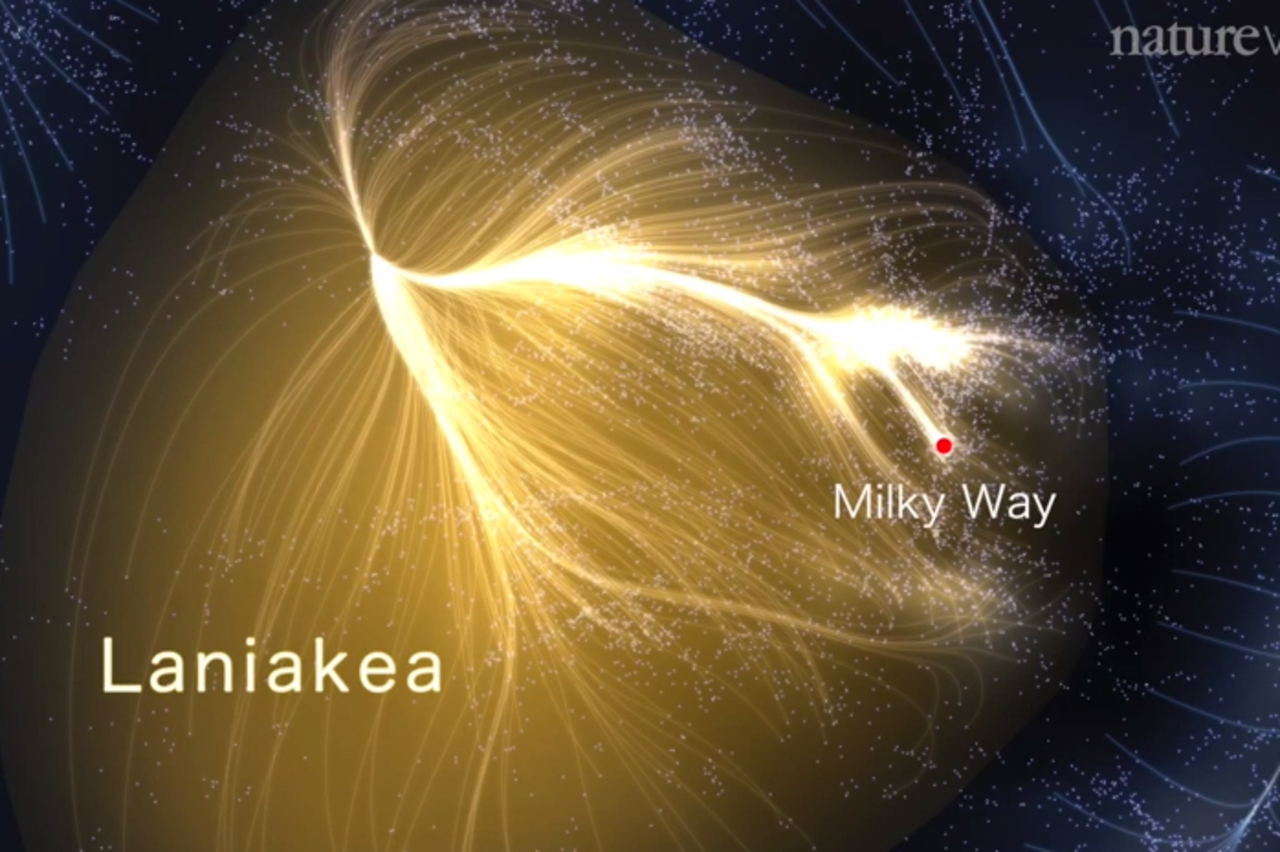
This is perhaps the most surprising map of all. Think about yourself for a moment. You’re a pretty big deal, right? The things that happen to you feel very consequential, don’t they? And for you, and your family, and your friends, they are. But this is a map of our corner of the universe. It’s called Laniakea and it’s got more than 100,000 galaxies and stretches more than 500 million light years across. You can’t even see earth in it, much less your city, much less your house. "It’s hard to wrap one’s head around how enormous this is," writes Brad Plumer. "Each of those points of light is an individual galaxy. Each galaxy contains millions, billlions, or even trillions of stars. Oh, and this all is just our little local corner of an even broader universe. There are many other galaxy superclusters out there." You can see more in this videofrom Nature. It kind of puts things in perspective, doesn’t it?
Subscribe to:
Posts (Atom)